Angled-Pile Weatherstrip
Pile set at an angle to the backing rather than square to it. In a retractable screen track the leaning filament reaches into the mesh instead of stopping at it, so the edge stays closed while the screen travels. We run this from 30° to 90°, built to your drawing.
Made to order Backing width, pile height, fin, colour — all specified by you. Standard sizes run on existing tooling; non-standard is the larger half of what we run.
Also called angled pile, angle pile weatherstrip, angled brush strip, retractable screen pile, screen track brush, angled weatherpile, slanted pile weatherstrip and insect screen edge brush.
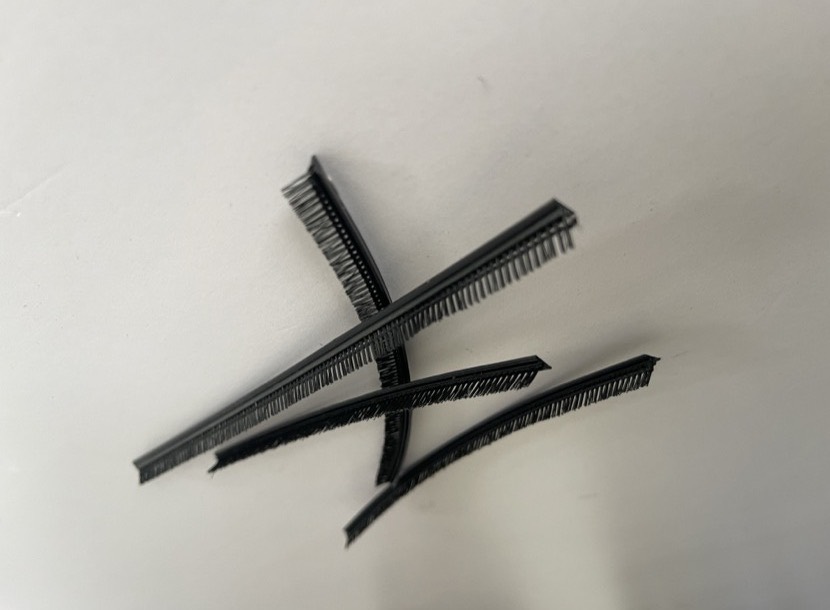
Made to your channel, not ours
The two dimensions called out on that drawing are both yours to set. The two things most often changed on this line are the pile angle and the pile height.
No tooling charge
- Pile height
- Anything from 2.5 mm upward
- Fin or no fin
- Added or removed on any construction
- Silicone treatment
- Siliconized filament on any size we make
- Put-up
- Spool length and core to suit your requirement
- Private label
- Your label on the spool flange, printed with your size, colour and quantity — we already run this for other buyers
New tooling, on us
- Colour
- Multiple standard; custom matched on request
- Non-standard backing width
- We cut the die and carry the cost — nothing to pay up front
- Non-standard backing profile
- Same terms. Post us 50 mm of the extrusion and we cut to it; the die stays reserved to your part number
Send a drawing, and post us 50 mm or more of the extrusion — we match the backing to the section itself. Any tooling we have to cut is ours to pay for, and it stays reserved to your part number. Large suppliers sell from a fixed catalogue and treat a non-standard size as an inconvenience. We were built the other way round.
Why this construction
A square-set pile meets the screen mesh face on and stops there — the gap at the edge of the cloth stays open. Angling the filament lets it enter that gap and stay in it while the screen rolls up and down, which is what keeps leaves and insects out at the edge. It is also what holds a soft mesh in line: without pile in both side tracks the cloth has nothing to run against.
Where it is used
- Retractable insect screensSide tracks on roll-up and pleated screen doors and windows.
- Motorised screen and shade tracksWhere the cloth must stay in the track through repeated travel.
- Any track where the seal must reach into a gapRather than meet a flat surface square on.
Sizes
Ranges below apply to this line. The full backing-width table, with the U.S. nominal each size sits against, is on the specifications page.
| Attribute | Range |
|---|---|
| Pile angle | 30° – 90°, set from your drawing |
| Backing width | 4.5 – 11.0 mm (0.177″ – 0.433″) |
| Pile height | from 2.5 mm (0.098″) upward |
| Pile material | Polypropylene |
| Pile-to-backing bond | Heat-fused, polypropylene to polypropylene — no adhesive in the bond |
| UV stabilisation | Available on request — dosed to the filament, base yarns and backing film |
| Colours | Multiple standard; custom on request |
| Dimensional tolerance | ±0.15 mm |
| Standard spool length | Made to your put-up — tell us the run length |
| Minimum order quantity | Scales with price — small runs welcome, quoted per volume |
| Sample lead time | 15 days on existing tooling; 30 days if a new backing profile has to be cut |
| Production lead time | 15 days ex-works on a first order, from receipt of deposit. U.S. contract volumes have run 30–45 days. Add 10 days if the filament colour has to be spun to order. |
How to specify it
Four things get you a quote and a matched sample. If you only have two of them, send two.
- The pile angle you needOr send the drawing. We run 30° to 90° — the angle is what this line is for.
- The backing width you runGive it however you have it — .270″, 7 mm, or the die drawing. We convert.
- The pile height you needOr the gap you are sealing, if the height was never specified.
- Annual volume and colourRough is fine. It decides the run size, not the price of the sample.
Related lines
Spec sheet — Angled-pile weatherstrip
This line’s own sheet: its section drawing, its published ranges, and the backing-width routing table. Fields still being confirmed with the plant are marked as such rather than filled in with a guess.